Since the issue of whether or not bookstores should stock all SFF books has been going around recently, I figured I'd add my 2 cents worth as a bookseller.
Author Gregory Frost mentioned in "the Wild River Review" that Borders isn't stocking his newest novel, Lord Tophet.
His response to this is for people to buy books from independent bookstores rather than chain stores like Borders citing that they have a better selection and more knowledgeable staff.
I beg to differ. While I happen to work at a store that has the best selection in the country for SFF (and every other topic) unless I'm at a Bakka Phoenix books in Toronto, I've yet to see an independent that carried a prodigious amount of Sci-Fi or Fantasy. Yes, most chain stores carry the same selection (or a variation thereon) but that doesn't mean the independents carry more. Indeed, considering the fact that they have the same problems associated with stocking books (only a certain amount of money to spend on new titles, shelf space, sales data) their selection is probably going to be lower than a chain store unless you're lucky enough to find one that specializes in SFF.
And as for knowledgeable staff, I find the insinuation that chain workers don't know books rather insulting. The majority of people I've worked with decided to work at a bookstore because they love books. Does that mean each bookseller will love YOUR genre and know everything about it? No. Does that mean independent booksellers will all know about SFF and be better able to help you pick a book? No.
I'm great with the SFF section because that's what I love and read. Mysteries? Don't ask me, I haven't got a clue. I can show you books and give you an idea of what to expect from them, but I can't say 'you'll love it' because I haven't read it. And I'm not you so my tastes will differ.
And if you're going to boycot your chain store, you might as well cut out everyone and just buy from Amazon, something I generally don't push as it means people like me, who ARE knowledgeable, are slowly losing our jobs. Those discounts they give? They undercut the market so all stores - and that includes your independent bookstores, can't compete. And no, we can't give the same discounts. Why not? Because we have a building with stock that Amazon doesn't have. That building requires heating/AC, electricity, security, computers, cashiers, managers and - amazing thing here - customer service reps to help you find your books. People like me. People who have bills to pay and require that our company make a 'profit' so that we can get paid. Because let's not forget that bookselling is a BUSINESS. Nasty word, I know. But if we go out of business no one's going to find your books on the shelf because there won't be a shelf. And I personally like holding a book and reading a few pages when I buy one, so having to buy online does not appeal to me.
And people may not realize this but unlike with things like food and clothing the markup on books is not very high. Which means that the profit margin is already low, so discounting books makes it that much harder for bookstores to stay in the black.
Tobias Buckell's post made me glad I work at the store I do. I had no idea individual Borders stores could not modify their stock to match their demographic. The WBB is rather exceptional in that while most Chapters/Indigo stores get stocked by head office we have a buyer for our store exclusively (because we have so much extra space and therefore more ability to stock a larger selection of books). And our current management want to carry the widest variety we can - so if we hear about a book we can suggest it and, provided we're allowed to carry it, we'll get it in.
"Allowed to carry it?" You ask. That's right. There are many reasons why bookstores don't carry titles. Here is another post that made me feel a bookseller's perspective on the issue of skipping could be informative. The writer of this blog makes the comment that sales staff LIE about the availability of books, citing all sorts of fictitious reasons why they can't order books into their store. While it's possible the bookseller's don't know the reason and are therefore giving vagaries, the truth is that we're generally not told why books can't be ordered in (and this is from someone who has specifically ordered in hundreds of books). It's possible that smaller stores simply aren't allowed to order in stock for their stores and that is an explanation in itself. If head office won't let you there's nothing you can do. For my store, here are some other reasons why stock can't be ordered:
Out of print - that's what the screen will say. What does that mean? Any one of the following (and perhaps more). The point is, we're not told for sure so anything we say will be an educated guess.
- publisher pulled the book due to lousy sales (this happens faster than you'd expect)
- book went to a different format (from hardcover to softcover so hardcover isn't being printed anymore)
- book is being reprinted so no copies are currently available for order
- book does not have north american rights (yes, rights are sold by country, so not everything available in Africa will be sold in Canada - much to people's surprise. And this goes for things like Da Vinci Code coming out in paperback in England while it was still in hardcover in Canada/US)
- publisher went out of business
- publisher uses a distributer we don't deal with (aren't reliable for getting stock, don't have a high enough discount rate so we can sell books at a discount to customers, aren't returnable, etc.)
I'm sure I've missed a few reasons. At any rate, there are lots of reasons why a particular book won't be stocked. And right now here's a big one in Canada:
People are complaining about the exchange rate and the printed cost difference between books being sold in Canada and the US, making them not want to buy hard cover or trade paperback books (trades are the larger paperbacks that traditionally cost around $15-25). Our head office has stopped ordering a lot of midlist hardcover and trades because NO ONE WANTS TO SPEND THE MONEY right now. So we simply don't stock them unless someone asks at which point we'll request the book (and my guess is the smaller stores don't stock them even if someone asks). Ultimately, there are only so many books that can be stocked, and buying trends make a difference in what gets stocked and what doesn't. And if the company feels books are getting too expensive, it will cut back on the books by newer and midlist authors and stock more high selling titles and authors.
Another problem is with the order system itself. Take a title like Good Omens. It's a perennial best seller. The problem is, it's always in reprints. We get a bunch into the store, they sell out in a few weeks, and then we have to wait half a year to get it in again. By this time our computer system has decided it's not worth stocking the book because IT HASN'T SOLD IN SEVERAL MONTHS. So unless you've got a bookseller who recognizes the problem and puts in an order, the book stays gone. Now that's not the most common problem, the most common problem is an original order number that's too low so the book appears to sell less than it would otherwise have (ie, get in 10, sell out and when your 30 arrive everyone's already got it from Amazon or nearby stores - so it looks like the title doesn't sell as much and gets stocked at a lower count). Bookselling is not an exact science. It's hard to guess how well certain things will sell. Some books get a lot of copies ordered and don't sell at all. Other books are constantly in demand while still others are constantly out of stock.
Of all the posts on this issue, the one by G.B.H. Hornswoggler is the best that I've seen. He's in publishing on the marketing side, and therefore knows what he's talking from from a business perspective.
Things he mentions:
-stores aren't obliged to carry every book published (here here, though we do try), they have to pick and choose
"But bookstores are businesses, not public conveniences. No store has the responsibility to carry every book published -- although, to be honest, that's a straw-man argument, since no one is asking for that. (They're just wishing that their books, the books they like, and the books by their friends be spared the chopping block.) I market books for a living, so I can tell you an unpleasant truth: the order for any book, from any account, starts at zero. The publisher's sales rep walks in the door with tipsheets and covers, past sales figures and promotional plans, to convince that bookseller's buyer to buy that book. In many categories -- SFF is still one of them -- the chain buyers say "yes" the overwhelming majority of the time. But not all the time. Sometimes, that buyer is not convinced, and the order stays at zero."
THANK YOU. In addition to being a very clear, readable post, I also learned several new things about the book business.
There are more posts on the issue but I think this post is long enough. Bookselling is a business. To stay in business bookstores need to make a profit. That means being selective about what they carry. Which means, unfortunately, that some books get skipped. I'll finish by quoting a reader comment from Hornswaggler's post:
Showing posts with label Fantasy. Show all posts
Showing posts with label Fantasy. Show all posts
Monday, October 20, 2008


Wednesday, October 01, 2008
Elven Races in Fantasy Novels
Someone posted recently (can't remember where I saw it or I'd link to it to be sure I'm not misrepresenting their comments - so if someone can find it, I'd be obliged) that fantasy worlds should better represent real life. Not be modern or anything like that, but have more variety within races (there are quite a number of different shades and cultures of humans on earth, why aren't there that number of elves or dwarves, etc). It's a good question. One I've never asked before. Why aren't there several shades of elves? And are they necessary?
Races in fantasy sprang originally from fairy tales. Coming from European backgrounds, these races tended, like Europeans at the time, to be uniform. Tolkien 'updated' some of these races (making Elves human height for instance) but left other things the same, mainly their general uniformity (I did mention in my last post that he had more than one type of Elf - forest Elves that pop up in the Hobbit and are disliked by their more cultured cousins from the Lord of the Rings). But for the most part there is little distinction.
I imagine, like me, most authors stick with the classics. Why invent new monsters and races when mythology is chock full of copywriteless creatures? And they can be used in so many ways, tailored to fit each world's individual needs. Want your elves to be taller than humans? Shorter? Live 500 years? 5000? Only 50? Have pointed ears with lobes? Without lobes? 'Not much variation' you think? Well, consider that each creature, each world, each character and each plot has variations and the number of books you can get from them are endless. Some of these ideas are so standard as to be almost cliche - like the members in the questing band (the thief, the warrior, the magician,...). But you can get some pretty original ideas as well.
Even with worlds like Forgotten Realms, the traditional ideas were not tinkered with too much. There are surface (happy, good, white skinned) Elves and the Drow (dark skinned, evil Elves that live underground). Why did they only create 2 kinds and why are they using what must be (nowadays - remember this idea is over 15 years old) considered racist? Is it the simplistic 'white hats' vs 'black hats' mentality that created this? I don't know and for my purposes here it doesn't matter except to say that a lot of novelists have followed their lead and having 2 races of Elves is now an almost traditional element in it's own right. In terms of dealing with racism in the books they've used their races to good purpose. Most notably in the character of Drizzt Do'Urden, the drow warrior who forsakes his dark kin and lives on the surface. In each of the books he has to overcome racial prejudice. But I digress.
This doesn't explain why more modern fantasy doesn't include more varied subraces. One idea (and probably mine, as I've only got one race of Elves in the books I write) is that there's simply no time. There's no time to explain why you have so many subraces. There's only so much space in a book. If I have to explain the world, the history, the characters and tell the plot I don't have room to explain the entire evolutionary background or introduce dozens of smaller tribes - unless doing so adds something to the novel. In other words, keeping to a few standard races allows for differences without bogging a book down with too much explanation (now, there are authors who can accomplish all of this, and I take my hat off to them, but I understand why the majority don't bother).
Another possibility is that many books take place in a small geographical area. Given the traditional medieval setting (which not everyone uses but enough do for me to emply that in my example) travel is difficult and touring the world likely unrealistic. So encountering a few new races and varied cultures is understandable, encountering dozens, probably less so (unless you end up a central trading post where people from all over the world congregate or something).
What I'm saying here is the complaint is valid but there are equally valid reasons for why we're not seeing it addressed. Maybe people will address the point in the future. Maybe they won't. So long as people keep writing good fantasy I'll keep reading it, whether they use 1 race of Elves, 20, or none.
Races in fantasy sprang originally from fairy tales. Coming from European backgrounds, these races tended, like Europeans at the time, to be uniform. Tolkien 'updated' some of these races (making Elves human height for instance) but left other things the same, mainly their general uniformity (I did mention in my last post that he had more than one type of Elf - forest Elves that pop up in the Hobbit and are disliked by their more cultured cousins from the Lord of the Rings). But for the most part there is little distinction.
I imagine, like me, most authors stick with the classics. Why invent new monsters and races when mythology is chock full of copywriteless creatures? And they can be used in so many ways, tailored to fit each world's individual needs. Want your elves to be taller than humans? Shorter? Live 500 years? 5000? Only 50? Have pointed ears with lobes? Without lobes? 'Not much variation' you think? Well, consider that each creature, each world, each character and each plot has variations and the number of books you can get from them are endless. Some of these ideas are so standard as to be almost cliche - like the members in the questing band (the thief, the warrior, the magician,...). But you can get some pretty original ideas as well.
Even with worlds like Forgotten Realms, the traditional ideas were not tinkered with too much. There are surface (happy, good, white skinned) Elves and the Drow (dark skinned, evil Elves that live underground). Why did they only create 2 kinds and why are they using what must be (nowadays - remember this idea is over 15 years old) considered racist? Is it the simplistic 'white hats' vs 'black hats' mentality that created this? I don't know and for my purposes here it doesn't matter except to say that a lot of novelists have followed their lead and having 2 races of Elves is now an almost traditional element in it's own right. In terms of dealing with racism in the books they've used their races to good purpose. Most notably in the character of Drizzt Do'Urden, the drow warrior who forsakes his dark kin and lives on the surface. In each of the books he has to overcome racial prejudice. But I digress.
This doesn't explain why more modern fantasy doesn't include more varied subraces. One idea (and probably mine, as I've only got one race of Elves in the books I write) is that there's simply no time. There's no time to explain why you have so many subraces. There's only so much space in a book. If I have to explain the world, the history, the characters and tell the plot I don't have room to explain the entire evolutionary background or introduce dozens of smaller tribes - unless doing so adds something to the novel. In other words, keeping to a few standard races allows for differences without bogging a book down with too much explanation (now, there are authors who can accomplish all of this, and I take my hat off to them, but I understand why the majority don't bother).
Another possibility is that many books take place in a small geographical area. Given the traditional medieval setting (which not everyone uses but enough do for me to emply that in my example) travel is difficult and touring the world likely unrealistic. So encountering a few new races and varied cultures is understandable, encountering dozens, probably less so (unless you end up a central trading post where people from all over the world congregate or something).
What I'm saying here is the complaint is valid but there are equally valid reasons for why we're not seeing it addressed. Maybe people will address the point in the future. Maybe they won't. So long as people keep writing good fantasy I'll keep reading it, whether they use 1 race of Elves, 20, or none.
Tuesday, September 30, 2008
What is Fantasy?
I've been seeing a lot of posts and articles recently complaining that fantasy keeps doing the same thing over and over again and that people would like to see something different. "Don't give me quest stories", "Don't have an older mentor figure", "Have more beta main characters who stay beta characters", "Make the worlds more realistic by adding more diverse subraces to the races involved (ie, several shades of elves)".
So I've decided to ask, what is fantasy? Why do people still read Tolkien if they don't like quests or mentors or one race of elves (there's actually more than one, indicating that these people didn't read Tolkien very closely anyway)?
The obvious response is the people complaining are only a small group of readers, people who like the idea of the genre but don't actually LIKE the genre. It's sort of like me with romance novels. I like romance, I like the idea of romance, I just don't like romance novels. Why? Because they're too fake. They all end happily. The characters go out of their way to cause problems. They never tell the truth, they never discuss issues that might become problems, they never clarify their meanings so their partner understands the real issue/emotion being discribed, they never ... you get the picture. But what's a romance novel without the twists and turns brought out by the lies and miscommunications? What's a romance novel without the happy ending? General fiction.
Fantasy is the modern fairy tale. I don't read it as escapism. I don't read it because nifty things happen to interesting people (though that's always a bonus). I read it because it makes me think about life and the issues brought up by life that everyone must face. Coming of age, falling in love, learning to depend on yourself, learning to depend on others, facing trials and overcoming them. These are the things myths did for people of the past (and remember that in the past what we term myths were considered religion). Myths explained why people act the way they do, helped people overcome difficulties, gave people hope. That's what fantasy does today. At least, that's what good fantasy today does for me.
The best fantasy in my mind is the type that makes me think. It has philosophical messages about life that are worked into the plot by means of the characters development rather than preached forcefully. Terry Brooks did an excellent job of this in The Sword of Shannara, the book that caused me to fall in love with the genre. It's a 'traditional, epic fantasy'. Quest - check. Elderly mentor - check. Magic - check. A diverse group of questors (meaning, an elf - well, half-elf in this case, a dwarf, various humans) - check. Does the novel still sell? - check. Which means that despite the fact that it's older than I am, this kind of fantasy is still popular (especially considering the second book in the series, The Elfstones of Shannara, has been optioned for a movie). And look at Eragon. I won't explain why I disliked the book here, suffice it to say, here's a traditional quest story using all the elements (minus the mixed group) that has done exceedingly well. And it wasn't even well written! So obviously there is a market for traditional fantasy.
Now I'm not saying that it isn't refreshing to read something different every now and then. And there are several excellent authors who are reinventing the genre. Nor am I saying that having more diverse subraces is a bad thing (though I do think the person who posted that should read more fantasy as I can name authors who do use more than one type of elf for example). What I am saying is a lot of us like traditional fantasy. We like our stories set in a medieval European feudalistic system. We like knowing that the main character is learning from a mentor (don't we all want a mentor who will guide us along life's path? - and it's hard to be mentored by someone younger than you, and even harder to learn everything on your own). We like seeing main characters who can make tough decisions, knowing they might not like the consequences but accepting that as a necessary evil (as opposed to 'beta' characters who, let's face it, will always be asking the other characters for advice as they won't know what to choose or want to take responsibility for those choices, or whining about how they don't want to do the quest at all for most of the novel). We want happy endings, or at least endings that allow us to believe brighter days are coming (if an author ends the novel negatively I might think it was a good ending that matched the story but I probably won't pick up their next book).
These are the elements that make up fantasy. Yes, you can leave some elements out. No, you don't have to have lots of philosophy in your book to have a good read. The beauty of fantasy is that it embraces so many subgenres and allows for a lot of diverse interpretations.
My point? Saying you want a fantasy without the fantasy elements that have always made up the genre is like saying you want a romance without, well, the romance. It might work for some people but the rest of us like our genre. That's why we keep reading (and writing) it.
So I've decided to ask, what is fantasy? Why do people still read Tolkien if they don't like quests or mentors or one race of elves (there's actually more than one, indicating that these people didn't read Tolkien very closely anyway)?
The obvious response is the people complaining are only a small group of readers, people who like the idea of the genre but don't actually LIKE the genre. It's sort of like me with romance novels. I like romance, I like the idea of romance, I just don't like romance novels. Why? Because they're too fake. They all end happily. The characters go out of their way to cause problems. They never tell the truth, they never discuss issues that might become problems, they never clarify their meanings so their partner understands the real issue/emotion being discribed, they never ... you get the picture. But what's a romance novel without the twists and turns brought out by the lies and miscommunications? What's a romance novel without the happy ending? General fiction.
Fantasy is the modern fairy tale. I don't read it as escapism. I don't read it because nifty things happen to interesting people (though that's always a bonus). I read it because it makes me think about life and the issues brought up by life that everyone must face. Coming of age, falling in love, learning to depend on yourself, learning to depend on others, facing trials and overcoming them. These are the things myths did for people of the past (and remember that in the past what we term myths were considered religion). Myths explained why people act the way they do, helped people overcome difficulties, gave people hope. That's what fantasy does today. At least, that's what good fantasy today does for me.
The best fantasy in my mind is the type that makes me think. It has philosophical messages about life that are worked into the plot by means of the characters development rather than preached forcefully. Terry Brooks did an excellent job of this in The Sword of Shannara, the book that caused me to fall in love with the genre. It's a 'traditional, epic fantasy'. Quest - check. Elderly mentor - check. Magic - check. A diverse group of questors (meaning, an elf - well, half-elf in this case, a dwarf, various humans) - check. Does the novel still sell? - check. Which means that despite the fact that it's older than I am, this kind of fantasy is still popular (especially considering the second book in the series, The Elfstones of Shannara, has been optioned for a movie). And look at Eragon. I won't explain why I disliked the book here, suffice it to say, here's a traditional quest story using all the elements (minus the mixed group) that has done exceedingly well. And it wasn't even well written! So obviously there is a market for traditional fantasy.
Now I'm not saying that it isn't refreshing to read something different every now and then. And there are several excellent authors who are reinventing the genre. Nor am I saying that having more diverse subraces is a bad thing (though I do think the person who posted that should read more fantasy as I can name authors who do use more than one type of elf for example). What I am saying is a lot of us like traditional fantasy. We like our stories set in a medieval European feudalistic system. We like knowing that the main character is learning from a mentor (don't we all want a mentor who will guide us along life's path? - and it's hard to be mentored by someone younger than you, and even harder to learn everything on your own). We like seeing main characters who can make tough decisions, knowing they might not like the consequences but accepting that as a necessary evil (as opposed to 'beta' characters who, let's face it, will always be asking the other characters for advice as they won't know what to choose or want to take responsibility for those choices, or whining about how they don't want to do the quest at all for most of the novel). We want happy endings, or at least endings that allow us to believe brighter days are coming (if an author ends the novel negatively I might think it was a good ending that matched the story but I probably won't pick up their next book).
These are the elements that make up fantasy. Yes, you can leave some elements out. No, you don't have to have lots of philosophy in your book to have a good read. The beauty of fantasy is that it embraces so many subgenres and allows for a lot of diverse interpretations.
My point? Saying you want a fantasy without the fantasy elements that have always made up the genre is like saying you want a romance without, well, the romance. It might work for some people but the rest of us like our genre. That's why we keep reading (and writing) it.
Tuesday, March 25, 2008
Author genders
Does it really matter what gender an author is? I know a man who swears he can tell if an author is a man or a woman simply by the writing. I've never been able to tell. Then again, I've never really felt the need to guess. If the author's name is Isaac, I simply assume it's a man. If it's Patricia, it's a woman. Things get a bit trickier when the name is Mercedes or Pat. And once they only use initials, it's traditionally presumed it's a woman (because women in SF used to want to hid that fact) so C. L. Wilson and P. N. Elrod are both women. Having said that (and not knowing the 'rule' when I was younger) it's only recently that I discovered P. N. Elrod is a woman. And the 'rule' doesn't work anymore. S. C. Butler is a man. As is S. M. Peters.
So if the name isn't always a clue, you go to the author photo on the back, right? Unfortunately not every book sports an author photo and some back covers manage to not detail the gender of the author either. Take this author blurb for example: Rob Thurman lives in Indiana. Nightlife is Rob's first novel. Visit the author on the Web at www.robthurman.net.
Can you imagine my surprise when, after reading the books and going to the site, I discovered that Rob Thurman is a woman? I saw her photo and thought 'cool, he put up a photo of his wife and his dog. That's awesome.' Didn't occur to me until I was reading her blog that that might be her photo. All because her name is Rob. (It's short for Robyn.) Then again, it might not. Does it matter? Does the quality of the book change? Oddly enough it does. On the surface.
Assuming the author was a man, writing about men, of whom he'd know a lot, the books were great. They had action, a bit of emotion, lots of swearing. The two male protagonists are so well depicted I had no problem understanding their motivations for anything.
Knowing the author is a woman, writing about men, of whom she obviously knows a lot, the books are phenomenal.
Why should this be? Why should I be surprised that a woman can write a convincing, kick-ass male character? Am I surprised when men write well-rounded female characters? No. So what's the difference?
My bookshelves are filled with female writers telling the stories of men, and well told they are too: Lois McMaster Bujold's Illvin in Paladin of Souls (I'd use the Barrayar books but I haven't read them yet), Gail Martin's Martris Drayke in the Summoner, Carol Berg's Seyonne in Transformation, Mercedes Lackey's Vanyel in Magic's Pawn. The list can go on.
So what is the difference? Maybe, by mistaking the author's gender, I was more willing to accept that the characterization was accurate. However, discovering my mistake, the characterization remains accurate, only my perception in reference to it changes. In other words, there is no difference other than my acknowledging that I made a mistake in assuming the author's gender was male.
It makes me think of the Victorian era when women often had to pose as men in order to be published. Sometimes the opposite would occur though, and men would write as women, so their female characters would be better received. Apparently guessing the genders of known anonymous and pseudonymous authors based on analysis of the text was a bit of a pastime for critics. I can see why.
I think it would be interesting to read a book without having any clues about the author to see if, based on the writing alone, I could guess the gender. It would also be interesting to read a book without any prejudice towards either the author or the characters, accepting the characters for who they are, rather than as a possible reflection of the author's gender.
Does the author's gender matter? Is the writing better or worse? Ultimately that depends on the author. A good author can see through the eyes of his/her character and write the character's story as it's meant to be. Whatever else we bring to the story, that's our problem.
So if the name isn't always a clue, you go to the author photo on the back, right? Unfortunately not every book sports an author photo and some back covers manage to not detail the gender of the author either. Take this author blurb for example: Rob Thurman lives in Indiana. Nightlife is Rob's first novel. Visit the author on the Web at www.robthurman.net.
Can you imagine my surprise when, after reading the books and going to the site, I discovered that Rob Thurman is a woman? I saw her photo and thought 'cool, he put up a photo of his wife and his dog. That's awesome.' Didn't occur to me until I was reading her blog that that might be her photo. All because her name is Rob. (It's short for Robyn.) Then again, it might not. Does it matter? Does the quality of the book change? Oddly enough it does. On the surface.
Assuming the author was a man, writing about men, of whom he'd know a lot, the books were great. They had action, a bit of emotion, lots of swearing. The two male protagonists are so well depicted I had no problem understanding their motivations for anything.
Knowing the author is a woman, writing about men, of whom she obviously knows a lot, the books are phenomenal.
Why should this be? Why should I be surprised that a woman can write a convincing, kick-ass male character? Am I surprised when men write well-rounded female characters? No. So what's the difference?
My bookshelves are filled with female writers telling the stories of men, and well told they are too: Lois McMaster Bujold's Illvin in Paladin of Souls (I'd use the Barrayar books but I haven't read them yet), Gail Martin's Martris Drayke in the Summoner, Carol Berg's Seyonne in Transformation, Mercedes Lackey's Vanyel in Magic's Pawn. The list can go on.
So what is the difference? Maybe, by mistaking the author's gender, I was more willing to accept that the characterization was accurate. However, discovering my mistake, the characterization remains accurate, only my perception in reference to it changes. In other words, there is no difference other than my acknowledging that I made a mistake in assuming the author's gender was male.
It makes me think of the Victorian era when women often had to pose as men in order to be published. Sometimes the opposite would occur though, and men would write as women, so their female characters would be better received. Apparently guessing the genders of known anonymous and pseudonymous authors based on analysis of the text was a bit of a pastime for critics. I can see why.
I think it would be interesting to read a book without having any clues about the author to see if, based on the writing alone, I could guess the gender. It would also be interesting to read a book without any prejudice towards either the author or the characters, accepting the characters for who they are, rather than as a possible reflection of the author's gender.
Does the author's gender matter? Is the writing better or worse? Ultimately that depends on the author. A good author can see through the eyes of his/her character and write the character's story as it's meant to be. Whatever else we bring to the story, that's our problem.
Sunday, March 02, 2008
Heroes Adrift - Book Review
 By: Moira Moore
This is the third in her Shield and Source series, told from Shield Dunleavy Mallorough's point of view. Like the first two novels, there's a fair bit of comedy associated with the opposites forced to work together motif. In this book, the pair are sent off to a southern island where they must find the off shoot relatives of the queen. Unfortunately, the islanders don't follow continental laws, and they expect the pair to pay for things (which tradition states they should receive for free). Needless to say, our rather unskilled heroes must use drastic measures to ensure they've got food and shelter. Enter: Leavy the Flame Dancer!
And Shintaro is not happy about it.
Here's the spoiler area. If you haven't read the book yet, don't read this or it will ruin a major plot twist for you.
Against the rules of their order Lee and Taro finally succumb to their attraction. I'm glad the author wrote this scene the way she did. In the segment where Lee is under the control of music and comes close to sleeping with Taro she would have had a perfect excuse to discount the entire affair. But I think that would have crushed Taro's already fragile self-esteem, especially with the treatment he was getting from the islanders. I like the fact that Lee sat down and examined her motives and decided that if she went ahead with this, she should do it with her eyes open, accepting of the possible consequences down the road. I think this acknowledgement is the reason Taro is willing to forgo his flirtatiousness at the end of the book (that and I think he honestly loves Lee. Here's a woman who's opinion matters highly to him and who accepts him as he is, whether he looks immaculate or disheveled. And given his upbringing he's likely never encountered anyone like her before). Unfortunately, I'm afraid that the Moonlighting effect will set in. Once characters sleep together the sexual tension, and the verbal sparring that comes from it, inevitably tones down. Even if conflict arises and they break up things can never go back to the way they were before.
Still, I'm looking forward to the next book to see how their new relationship works out once they're back in High Scape where what they're doing is against the rules.
Sunday, February 24, 2008
The Last Wish - Book Review
 The Last Wish by Andrzej Sapkowski is the European inspiration for the video game, the Witcher. It came out in trade paperback last year and will soon find its way to bookshelves as a well priced mass market paperback.
The novel is written as a series of short stories, flashback missions, Geralt, the Witcher, has undertaken. Between these tales is a frame story that slowly brings them all together into a cohesive whole.
The stories are interesting, showing a strange melding of mythology and reality, fairy tales and unhappy endings as Geralt must decide if the creature he's stumbled across or been hired to kill truly deserves death. Necessarily moralistic at times The Last Wish will have you questioning your own perceptions as the Witcher makes difficult choices.
The only problem I had with the book was that each story is left incomplete. You know enough to want to know more but you're not told that last little bit that would satisfy you.
Still, it's a unique book that's worth the time (and at $8.50 Cdn, you can hardly beat the price).
Friday, February 08, 2008
The Hero Strikes Back - Book Review


The second in a delightful series by Moira Moore, this book with have you rolling on the floor with laughter. I read it, read it again and then skimmed it several times. It's got two completely opposite personalities forced to work together by their pair bond as Source (channeling the forces that cause natural disasters) and Shield. Lee is the perfect narrator. Snarky and opinionated, yet she rarely shares what she's thinking, or feeling, which drives her partner nuts. I can't wait for the third book to come out!
Saturday, October 27, 2007
Skewed Throne - Book Review

I just finished reading Joshua Palmatier's debut novel, the third of which, the Vacant Throne, comes out in January.
Varis, the main character, is a street urchin, mistrustful, wary and fast. As the novel progresses, she develops another skill, assassination. But unlike other books where theft and killing are the protagonists occupation, she takes no pleasure in her skill. (I'm thinking here specifically of Jimmy the Hand, who didn't like being a thief but took great pride in being a great thief.)
At first I thought it strange that we see so much emotion from her. Whenever she kills someone in self-defense she breaks down and sobs. Later on though, I realized what the author was doing. Normally, by the end of the book, with what she'd turned into, I would have found my sympathy waning, might have put the book down being no longer able to empathize with the main character (if I don't care what happens to the main character, why keep reading? For this reason I was never able to finish book one of Stephen Donaldson's White Gold Wielder series, from about page 60 I wanted him to fail the quest. Since logic dictated that he wouldn't I had no desire to read on. I had no sympathy for the character's plight and only disgust for his choices). The same might have held true for Varis except for that gleam of humanity that her life as an assassin can't diminish. She sobs. She has a conscience and continually sees the faces of the people she has killed.
Now that's not to say that a conscienceless protagonist isn't fun at times. I love the Dexter books by Jeff Lindsay. But the direction of those books is entirely different. They're designed to show, in a darkly humourous way, what humanity is capable of. You laugh as you read the books and feel slightly chilled at the end. The horror though, comes from the thought of meeting someone in real life like that, where the situation would be anything but funny.
But back to Varis. The end of the book works. You look over the course of her life and see both how she ends up there and how that seems right for her. A masterful story with amazing character development.
You can check out Joshua's website here.
Thursday, October 18, 2007
Lord of the Fading Lands - Book Review
Well, a lot has happened since I last posted. I've moved, I've cut my hair short and a review I wrote has been quoted in the author's book! Here's the full review, though only the last line made the novel.
 Lord of the Fading Lands
By: C. L. Wilson
If you enjoy the blend of romance and fantasy employed by LUNA books, then you will love this new book by Dorchester Publishing: Lord of the Fading Lands.
C.L. Wilson’s city of Celieria is impeccably detailed and populated with an interesting and yet wholly realistic cast of characters.
The Fey Truthspeaker is coming for her annual visit, and this year the Feyreisen, King of the Fey, is accompanying her. He is searching for the woman whom their oracle showed could save the dying tairen, magical winged cats, whose fates are intertwined with those of his people.
Little does he realize that this woman is his shei’tani, his soul-mate, and that she is already unwillingly betrothed to another. As if that weren’t enough, the Eld, mages and ancient enemy of the Fey, are plotting once more.
This debut will draw you into a magical weave of spirit and air that won’t release you until the last word is read.
If you want to see the rest of the reviews, check out the World's Biggest Bookstore's Sci-Fi Fan Letter here.
 Lord of the Fading Lands
By: C. L. Wilson
If you enjoy the blend of romance and fantasy employed by LUNA books, then you will love this new book by Dorchester Publishing: Lord of the Fading Lands.
C.L. Wilson’s city of Celieria is impeccably detailed and populated with an interesting and yet wholly realistic cast of characters.
The Fey Truthspeaker is coming for her annual visit, and this year the Feyreisen, King of the Fey, is accompanying her. He is searching for the woman whom their oracle showed could save the dying tairen, magical winged cats, whose fates are intertwined with those of his people.
Little does he realize that this woman is his shei’tani, his soul-mate, and that she is already unwillingly betrothed to another. As if that weren’t enough, the Eld, mages and ancient enemy of the Fey, are plotting once more.
This debut will draw you into a magical weave of spirit and air that won’t release you until the last word is read.
If you want to see the rest of the reviews, check out the World's Biggest Bookstore's Sci-Fi Fan Letter here.
Tuesday, August 14, 2007
Sleeping God - Book Review
 Violette Malan has crafted another marvelous novel. This one (as opposed to Mirror Prince, her first) takes place entirely in a fantasy world. Dhulyn Wolfshead is a mercenary brother, Partnered to Parno Lionsmane, and a Marked Seer. Their story is captivating (I had trouble putting the book down to go to sleep and ended up reading a few extra hours). The country they travel through in this book is being turned against the Marked, persecuting and casting them out much the way the Nazi's did to the Jews before WWII. What makes the novel stand out, is that the propaganda is so well written you almost believe the priests that the Marked are evil, before being pulled back from the hysteria and seeing it for what it is. Misapplied logic. The ending is very satisfying, making you wonder how you missed predicting it.
The Blade Itself - Book Review
Alright, so I've finished The Blade Itself by Joe Abercrombie. And boy was it ever a good read. My only complaint was that there was too much swearing. I know people think it's more 'realistic', but honestly, what's realistic about an old bald, bearded wizard mouthing off? Can you picture Gandolf asking what the S**t is wrong with kids nowadays? I can't. And really, the excessive use made the scenes where it would have added to the effect paler by comparison. Consider the lack of effect the one swear word in book 7 of Harry Potter would have had if we'd seen that character (or indeed any characters) swear excessively in that or earlier books. The line works so well that my roommate almost fell off the couch when she read it.
Still, if you want a phenomenal read, with gritty realism concerning magic, barbarian living and war (not to mention some delightfully hateful characters) than definitely pick up this book.
Still, if you want a phenomenal read, with gritty realism concerning magic, barbarian living and war (not to mention some delightfully hateful characters) than definitely pick up this book.
Sunday, August 05, 2007
World's Biggest Bookstore's Sci-Fi Fan Letter
The store's science fiction and fantasy newsletter I edit is now online! Visit it at www.scififanletter .blogspot.com There you'll find all our back issues as well as photos from sci-fi related events in store. You'll also find links to various publishers' websites and a listing of books coming out next month. You can also sign up to have the newsletter emailed to you each month by sending a blank email to:
scififanletter@gmail.com Simply put 'subscribe' in the subject line and you're in.
scififanletter@gmail.com Simply put 'subscribe' in the subject line and you're in.
Friday, August 03, 2007
Stardust - Movie Review
 The movie has been dubbed the new Princess Bride. As someone who's read the story, I couldn't understand how this could be. The story is not at all humourous. It's about a young man who decides he will prove his love to a rather haughty young lady by bringing her a fallen star. Yet, the movie achieves a sort of delightfully evil slant that makes you laugh while at the same time makes you wonder if you really should be laughing. In other words, it's very British.
 But most importantly, the movie stars Mark Strong as Septimus, one of several brothers sent to find the necklace that knocked the star out of the sky. And his performance is as masterful as the one he gave in the 1997 version of Emma when he played Mr. Knightley to perfection. It was quite a joy to be sitting in the theater and seeing him appear on screen. Especially when none of the ads for the film mention him (which is a c

 rying shame).
The Slacker
Once again I've been slacking off. At least as far as this blog's concerned.
From now on I'll probably be changing the content of this site to what I'm currently reading at any given time. And as I read several books a week that should have me posting more often.
 My current book is the Blade Itself, due out in September from Pyr books. I'm only a few chapters in so far, but the book is wonderful. (In a scary, twisted sort of way - you'll understand that when you read the book.)
From now on I'll probably be changing the content of this site to what I'm currently reading at any given time. And as I read several books a week that should have me posting more often.
 My current book is the Blade Itself, due out in September from Pyr books. I'm only a few chapters in so far, but the book is wonderful. (In a scary, twisted sort of way - you'll understand that when you read the book.)
Monday, April 30, 2007
Anne Bishop Event


 Anne Bishop comes to the World's Biggest Bookstore for a reading from her new book Belladonna. And I got to meet her (and help set up the event). If you haven't already done so, check out her books!
Thursday, October 12, 2006
Sci-Fi Fan Letter
The World's Biggest Bookstore in Toronto now has a Science fiction / Fantasy newsletter. And guess who the 'editor-in-chief' is? Yours truly. I need some nifty things to add to cover letters when next I send in stories and novel proposals. For the first issue I reviewed Mirror Prince by Violette Malan (a budding local fantasy author) and Armageddon's Children in anticipation for Terry Brooks's visit to the store. The main feature is a listing of most of the sf/fan titles coming out in October. I'm busy at work getting the next issue ready. Right now the newsletter is only one side of one page (I had to prove to management that I could do it and do it fast) but I'm hoping to make it longer and have it include more content with various co-workers writing pieces. We'll see if that happens. In the meantime, it's fun going on all of the publisher's pages and seeing what's new. I also get to read books I otherwise might not pick up, like Koji Suzuki's Paradise. Of course, I can only review books I liked (since this is for a bookstore and it sounds bad if I say, "Don't buy the Da Vinci Code, it sucked" even if that's how I feel). This time around I had to read several books before finding one I liked. Ah, a writer's life is hard.
Tuesday, April 11, 2006
Why Wyvern's Peak Writing?
Why W P W?
Wyvern's Peak Writing probably strikes some of you as a strange name for a blog site. Actually it's a 'business' I've set up for my 'freelance' writing. The name comes from a fantasy trilogy I'm currently writing. Wyvern's Peak is the mountain where book 2 (oddly enough the first book of the trilogy I wrote) begins. I wanted something original that I could draw a neat icon for. Look out for the icon. It's drawn and coming as soon as I can figure out how to post pictures...
Wyvern's Peak Writing probably strikes some of you as a strange name for a blog site. Actually it's a 'business' I've set up for my 'freelance' writing. The name comes from a fantasy trilogy I'm currently writing. Wyvern's Peak is the mountain where book 2 (oddly enough the first book of the trilogy I wrote) begins. I wanted something original that I could draw a neat icon for. Look out for the icon. It's drawn and coming as soon as I can figure out how to post pictures...
Friday, April 07, 2006
Ad Astra
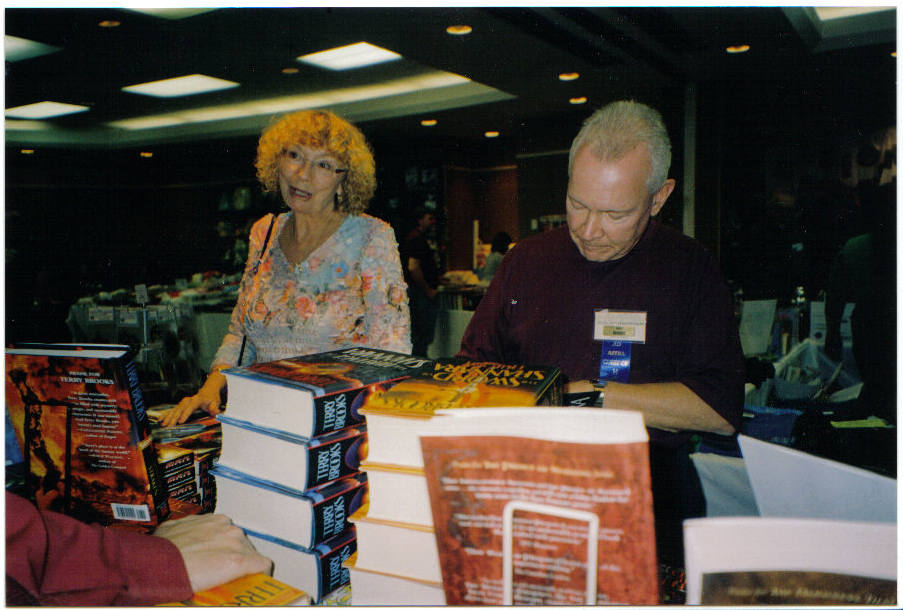 Have you ever attended an event that made you want to get out and do something? Last weekend was Ad Astra, Toronto's oldest science fiction/fantasy convention. Attending were some well known names in the industry, Terry Brooks, author of the Shannara series, the Magic of Landover books, the Knight of the Word trilogy and the novelization of Phantom Menace; Anne Bishop, author of the Black Jewels trilogy and the Pillars of the World; Ed Greenwood, who created the Forgotten Realms universe, Peter David, who has written so many star trek books it's not funny; and Betsy Mitchell, editor-in-chief of Del Rey publishing among others.
I ended up working the event instead of attending it (the World's Biggest Bookstore is back at conventions!) so I was only able to attend two events. I did however, talk to a few of the authors. Anne Bishop had a wonder quote for aspiring authors,
"The very best story you can write today is not the best story you can write."
So the next time you get a rejection letter from a publisher or editor, remember, the next story you write will be better.
Speaking of writing, I'd better go do some. Ad Astra gave me the impetus to start living my dream instead of just thinking about doing it. Sometime you need a good kick to start a project you've been thinking of for a long time. I've finally set up this blog, and I'm going to keep writing stories until they start getting published (and then I'm going to try to get my novels published).
Here's to inspiration!
The muse calls, so, as the Japanese would say, gambarimasho.
Subscribe to:
Posts (Atom)
This is just about one of the best posts on this subject I've ever seen. The comments about indies are spot on; as an agent I was amazed when the beloved Shakespeare & Co. had their bye-bye sale on the upper west side to see what books of mine they had quantity of that everyone else had returned, or in DC just this past month where Olsson's went out of business after years of having a very strange sf section. Always be glad there are two chains, since they tend not to screw up with the same books and authors. Borders skipped SLY MONGOOSE but has reordered the RAGAMUFFIN paperback, while a B&N that sells out of RAGAMUFFIN has seen the last of it. Borders carries Jim Hines, B&N does not. B&N spent 7 years loving Sookie Stackhouse more than Borders but since True Blood is out has fallen behind. For Elizabeth Moon, you want THE DEED OF PAKSENARRION in trade paperback go to Borders, you want the BRC trade paperback of THE SPEED OF DARK go to B&N and check the Fiction section. We need both of them. And both at bn.com and borders.com have features that allow you to plug in any zip code and check store availability nearby. Use that sucker; both chains have good and bad sf/fantasy stores and maybe you can drive five more minutes and actually find the book you want instead of bemoaning its absence.