There are several reasons people write. It's fun, they're hoping to get rich (and don't understand the reality of writing and publishing), they've got lots of time and nothing else to do.
Well, ok, I doubt that last one would come up. I know my time gets filled pretty quickly with necessary tasks (and fun tasks).
So why do I write? I guess like many authors who decided to start writing as a child I simply can't NOT write. I tried once. It didn't work. There are stories to be told and I'm the lucky one who has access to these stories. I guess that means that even if I never get published I will still write, because the stories want to be told. Even if it's just to me. And I love editing. I love changing around words on a page. I love seeing them join together in new ways, better than before.
And despite the amount of books out there and the number I've read there are still stories I'd like to see that no one else is writing. For quite some time while shelving chick lits I've read the descriptions on the backs of them, wanting to find one that I'd actually enjoy. I've even skimmed a few and gotten frustrated as the main character is similar to me in some ways but always has a high fashion sense (which I don't), and a high profile job (which I don't), and sleeps with every man who offers (which I don't). So to aleviate my desire to read a chick lit that I can relate to I wrote one. Which, now that it's finished, I've discovered is harder to sell than I thought. I doubt this is because there are no other tom boy style women who work retail and who don't think casual affairs lead to worthwhile relationships. But the publishing industry is set up to cater to those genres already selling. When something new comes along they're afraid of it because "how will it sell?". Which ulitmately is a valid point.
But I digress. I write because I like to. I write because I feel compelled to. And I write because I know no one else will write the stories I want to tell.
Thursday, October 02, 2008


Wednesday, October 01, 2008
Elven Races in Fantasy Novels
Someone posted recently (can't remember where I saw it or I'd link to it to be sure I'm not misrepresenting their comments - so if someone can find it, I'd be obliged) that fantasy worlds should better represent real life. Not be modern or anything like that, but have more variety within races (there are quite a number of different shades and cultures of humans on earth, why aren't there that number of elves or dwarves, etc). It's a good question. One I've never asked before. Why aren't there several shades of elves? And are they necessary?
Races in fantasy sprang originally from fairy tales. Coming from European backgrounds, these races tended, like Europeans at the time, to be uniform. Tolkien 'updated' some of these races (making Elves human height for instance) but left other things the same, mainly their general uniformity (I did mention in my last post that he had more than one type of Elf - forest Elves that pop up in the Hobbit and are disliked by their more cultured cousins from the Lord of the Rings). But for the most part there is little distinction.
I imagine, like me, most authors stick with the classics. Why invent new monsters and races when mythology is chock full of copywriteless creatures? And they can be used in so many ways, tailored to fit each world's individual needs. Want your elves to be taller than humans? Shorter? Live 500 years? 5000? Only 50? Have pointed ears with lobes? Without lobes? 'Not much variation' you think? Well, consider that each creature, each world, each character and each plot has variations and the number of books you can get from them are endless. Some of these ideas are so standard as to be almost cliche - like the members in the questing band (the thief, the warrior, the magician,...). But you can get some pretty original ideas as well.
Even with worlds like Forgotten Realms, the traditional ideas were not tinkered with too much. There are surface (happy, good, white skinned) Elves and the Drow (dark skinned, evil Elves that live underground). Why did they only create 2 kinds and why are they using what must be (nowadays - remember this idea is over 15 years old) considered racist? Is it the simplistic 'white hats' vs 'black hats' mentality that created this? I don't know and for my purposes here it doesn't matter except to say that a lot of novelists have followed their lead and having 2 races of Elves is now an almost traditional element in it's own right. In terms of dealing with racism in the books they've used their races to good purpose. Most notably in the character of Drizzt Do'Urden, the drow warrior who forsakes his dark kin and lives on the surface. In each of the books he has to overcome racial prejudice. But I digress.
This doesn't explain why more modern fantasy doesn't include more varied subraces. One idea (and probably mine, as I've only got one race of Elves in the books I write) is that there's simply no time. There's no time to explain why you have so many subraces. There's only so much space in a book. If I have to explain the world, the history, the characters and tell the plot I don't have room to explain the entire evolutionary background or introduce dozens of smaller tribes - unless doing so adds something to the novel. In other words, keeping to a few standard races allows for differences without bogging a book down with too much explanation (now, there are authors who can accomplish all of this, and I take my hat off to them, but I understand why the majority don't bother).
Another possibility is that many books take place in a small geographical area. Given the traditional medieval setting (which not everyone uses but enough do for me to emply that in my example) travel is difficult and touring the world likely unrealistic. So encountering a few new races and varied cultures is understandable, encountering dozens, probably less so (unless you end up a central trading post where people from all over the world congregate or something).
What I'm saying here is the complaint is valid but there are equally valid reasons for why we're not seeing it addressed. Maybe people will address the point in the future. Maybe they won't. So long as people keep writing good fantasy I'll keep reading it, whether they use 1 race of Elves, 20, or none.
Races in fantasy sprang originally from fairy tales. Coming from European backgrounds, these races tended, like Europeans at the time, to be uniform. Tolkien 'updated' some of these races (making Elves human height for instance) but left other things the same, mainly their general uniformity (I did mention in my last post that he had more than one type of Elf - forest Elves that pop up in the Hobbit and are disliked by their more cultured cousins from the Lord of the Rings). But for the most part there is little distinction.
I imagine, like me, most authors stick with the classics. Why invent new monsters and races when mythology is chock full of copywriteless creatures? And they can be used in so many ways, tailored to fit each world's individual needs. Want your elves to be taller than humans? Shorter? Live 500 years? 5000? Only 50? Have pointed ears with lobes? Without lobes? 'Not much variation' you think? Well, consider that each creature, each world, each character and each plot has variations and the number of books you can get from them are endless. Some of these ideas are so standard as to be almost cliche - like the members in the questing band (the thief, the warrior, the magician,...). But you can get some pretty original ideas as well.
Even with worlds like Forgotten Realms, the traditional ideas were not tinkered with too much. There are surface (happy, good, white skinned) Elves and the Drow (dark skinned, evil Elves that live underground). Why did they only create 2 kinds and why are they using what must be (nowadays - remember this idea is over 15 years old) considered racist? Is it the simplistic 'white hats' vs 'black hats' mentality that created this? I don't know and for my purposes here it doesn't matter except to say that a lot of novelists have followed their lead and having 2 races of Elves is now an almost traditional element in it's own right. In terms of dealing with racism in the books they've used their races to good purpose. Most notably in the character of Drizzt Do'Urden, the drow warrior who forsakes his dark kin and lives on the surface. In each of the books he has to overcome racial prejudice. But I digress.
This doesn't explain why more modern fantasy doesn't include more varied subraces. One idea (and probably mine, as I've only got one race of Elves in the books I write) is that there's simply no time. There's no time to explain why you have so many subraces. There's only so much space in a book. If I have to explain the world, the history, the characters and tell the plot I don't have room to explain the entire evolutionary background or introduce dozens of smaller tribes - unless doing so adds something to the novel. In other words, keeping to a few standard races allows for differences without bogging a book down with too much explanation (now, there are authors who can accomplish all of this, and I take my hat off to them, but I understand why the majority don't bother).
Another possibility is that many books take place in a small geographical area. Given the traditional medieval setting (which not everyone uses but enough do for me to emply that in my example) travel is difficult and touring the world likely unrealistic. So encountering a few new races and varied cultures is understandable, encountering dozens, probably less so (unless you end up a central trading post where people from all over the world congregate or something).
What I'm saying here is the complaint is valid but there are equally valid reasons for why we're not seeing it addressed. Maybe people will address the point in the future. Maybe they won't. So long as people keep writing good fantasy I'll keep reading it, whether they use 1 race of Elves, 20, or none.
Tuesday, September 30, 2008
What is Fantasy?
I've been seeing a lot of posts and articles recently complaining that fantasy keeps doing the same thing over and over again and that people would like to see something different. "Don't give me quest stories", "Don't have an older mentor figure", "Have more beta main characters who stay beta characters", "Make the worlds more realistic by adding more diverse subraces to the races involved (ie, several shades of elves)".
So I've decided to ask, what is fantasy? Why do people still read Tolkien if they don't like quests or mentors or one race of elves (there's actually more than one, indicating that these people didn't read Tolkien very closely anyway)?
The obvious response is the people complaining are only a small group of readers, people who like the idea of the genre but don't actually LIKE the genre. It's sort of like me with romance novels. I like romance, I like the idea of romance, I just don't like romance novels. Why? Because they're too fake. They all end happily. The characters go out of their way to cause problems. They never tell the truth, they never discuss issues that might become problems, they never clarify their meanings so their partner understands the real issue/emotion being discribed, they never ... you get the picture. But what's a romance novel without the twists and turns brought out by the lies and miscommunications? What's a romance novel without the happy ending? General fiction.
Fantasy is the modern fairy tale. I don't read it as escapism. I don't read it because nifty things happen to interesting people (though that's always a bonus). I read it because it makes me think about life and the issues brought up by life that everyone must face. Coming of age, falling in love, learning to depend on yourself, learning to depend on others, facing trials and overcoming them. These are the things myths did for people of the past (and remember that in the past what we term myths were considered religion). Myths explained why people act the way they do, helped people overcome difficulties, gave people hope. That's what fantasy does today. At least, that's what good fantasy today does for me.
The best fantasy in my mind is the type that makes me think. It has philosophical messages about life that are worked into the plot by means of the characters development rather than preached forcefully. Terry Brooks did an excellent job of this in The Sword of Shannara, the book that caused me to fall in love with the genre. It's a 'traditional, epic fantasy'. Quest - check. Elderly mentor - check. Magic - check. A diverse group of questors (meaning, an elf - well, half-elf in this case, a dwarf, various humans) - check. Does the novel still sell? - check. Which means that despite the fact that it's older than I am, this kind of fantasy is still popular (especially considering the second book in the series, The Elfstones of Shannara, has been optioned for a movie). And look at Eragon. I won't explain why I disliked the book here, suffice it to say, here's a traditional quest story using all the elements (minus the mixed group) that has done exceedingly well. And it wasn't even well written! So obviously there is a market for traditional fantasy.
Now I'm not saying that it isn't refreshing to read something different every now and then. And there are several excellent authors who are reinventing the genre. Nor am I saying that having more diverse subraces is a bad thing (though I do think the person who posted that should read more fantasy as I can name authors who do use more than one type of elf for example). What I am saying is a lot of us like traditional fantasy. We like our stories set in a medieval European feudalistic system. We like knowing that the main character is learning from a mentor (don't we all want a mentor who will guide us along life's path? - and it's hard to be mentored by someone younger than you, and even harder to learn everything on your own). We like seeing main characters who can make tough decisions, knowing they might not like the consequences but accepting that as a necessary evil (as opposed to 'beta' characters who, let's face it, will always be asking the other characters for advice as they won't know what to choose or want to take responsibility for those choices, or whining about how they don't want to do the quest at all for most of the novel). We want happy endings, or at least endings that allow us to believe brighter days are coming (if an author ends the novel negatively I might think it was a good ending that matched the story but I probably won't pick up their next book).
These are the elements that make up fantasy. Yes, you can leave some elements out. No, you don't have to have lots of philosophy in your book to have a good read. The beauty of fantasy is that it embraces so many subgenres and allows for a lot of diverse interpretations.
My point? Saying you want a fantasy without the fantasy elements that have always made up the genre is like saying you want a romance without, well, the romance. It might work for some people but the rest of us like our genre. That's why we keep reading (and writing) it.
So I've decided to ask, what is fantasy? Why do people still read Tolkien if they don't like quests or mentors or one race of elves (there's actually more than one, indicating that these people didn't read Tolkien very closely anyway)?
The obvious response is the people complaining are only a small group of readers, people who like the idea of the genre but don't actually LIKE the genre. It's sort of like me with romance novels. I like romance, I like the idea of romance, I just don't like romance novels. Why? Because they're too fake. They all end happily. The characters go out of their way to cause problems. They never tell the truth, they never discuss issues that might become problems, they never clarify their meanings so their partner understands the real issue/emotion being discribed, they never ... you get the picture. But what's a romance novel without the twists and turns brought out by the lies and miscommunications? What's a romance novel without the happy ending? General fiction.
Fantasy is the modern fairy tale. I don't read it as escapism. I don't read it because nifty things happen to interesting people (though that's always a bonus). I read it because it makes me think about life and the issues brought up by life that everyone must face. Coming of age, falling in love, learning to depend on yourself, learning to depend on others, facing trials and overcoming them. These are the things myths did for people of the past (and remember that in the past what we term myths were considered religion). Myths explained why people act the way they do, helped people overcome difficulties, gave people hope. That's what fantasy does today. At least, that's what good fantasy today does for me.
The best fantasy in my mind is the type that makes me think. It has philosophical messages about life that are worked into the plot by means of the characters development rather than preached forcefully. Terry Brooks did an excellent job of this in The Sword of Shannara, the book that caused me to fall in love with the genre. It's a 'traditional, epic fantasy'. Quest - check. Elderly mentor - check. Magic - check. A diverse group of questors (meaning, an elf - well, half-elf in this case, a dwarf, various humans) - check. Does the novel still sell? - check. Which means that despite the fact that it's older than I am, this kind of fantasy is still popular (especially considering the second book in the series, The Elfstones of Shannara, has been optioned for a movie). And look at Eragon. I won't explain why I disliked the book here, suffice it to say, here's a traditional quest story using all the elements (minus the mixed group) that has done exceedingly well. And it wasn't even well written! So obviously there is a market for traditional fantasy.
Now I'm not saying that it isn't refreshing to read something different every now and then. And there are several excellent authors who are reinventing the genre. Nor am I saying that having more diverse subraces is a bad thing (though I do think the person who posted that should read more fantasy as I can name authors who do use more than one type of elf for example). What I am saying is a lot of us like traditional fantasy. We like our stories set in a medieval European feudalistic system. We like knowing that the main character is learning from a mentor (don't we all want a mentor who will guide us along life's path? - and it's hard to be mentored by someone younger than you, and even harder to learn everything on your own). We like seeing main characters who can make tough decisions, knowing they might not like the consequences but accepting that as a necessary evil (as opposed to 'beta' characters who, let's face it, will always be asking the other characters for advice as they won't know what to choose or want to take responsibility for those choices, or whining about how they don't want to do the quest at all for most of the novel). We want happy endings, or at least endings that allow us to believe brighter days are coming (if an author ends the novel negatively I might think it was a good ending that matched the story but I probably won't pick up their next book).
These are the elements that make up fantasy. Yes, you can leave some elements out. No, you don't have to have lots of philosophy in your book to have a good read. The beauty of fantasy is that it embraces so many subgenres and allows for a lot of diverse interpretations.
My point? Saying you want a fantasy without the fantasy elements that have always made up the genre is like saying you want a romance without, well, the romance. It might work for some people but the rest of us like our genre. That's why we keep reading (and writing) it.
Thursday, August 21, 2008
Shut up, I'm Talking - Book Review
 This is the first biography I've reviewed, and possibly the only non-school related one I've ever read. And it was a good place to start. Mr. Levey tells the most impossibly hilarious stories, made that much more amusing because they're all true.
A Canadian citizen, he worked as a speech writer for the Israeli delegation to the United Nations in New York while, ostensibly, getting his law degree. He later did a stint in Israel working at the Prime Minister's office during a very turbulent time in Israeli politics.
The book tries not to be political, and succeeds for the most part. You get a glimpse of a foreign govenment peppered with amusing anecdotes from his personal life.
Good for anyone looking for something different yet amusing.
Wednesday, May 21, 2008
Spain 9
Madrid

 I was still a bit tired of seeing stuff. The museum I most wanted to see (military) was closed so I was out of luck on that. I didn't feel like paying to see the Prado so I went in the evenings when it was free. The Caixa Forum had a free Alphonse Mucha exhibit. The building next to it had one wall completely covered in plants. This was the day I splurged and had a traditional Spanish treat: chocolate con churros. Very tasty deep fried pastry dipped in strong but delicious hot chocolate (I think it was made in an espresso machine from actual cocoa beans).

 I just happened to be in town for the San Isidore festival, so I caught a parade one day and Naumagia, a display of lights and fountains, one night. I had a great seat for that and got some nice pictures of it.


 I also went to the Atoch train station on a tip from a friend. The center of the station has been made into a tropical garden. And the city is filled with all sorts of fountains, like this Neptune fountain.


 I also found two rose gardens in full bloom. One in the park where the Naumagia display was held, the other near my hostel, where (since I had to carry my backpack) I spent my last day in Spain. It had this gorgeous statue of a woman putting a flower in her hair. It was set back in the trees and stood in a fountain.
 And of course, who am I without books? I'd read the two I brought and wanted something else to read. I didn't find anything, but I did stumble on a fantasy and SF bookstore. Unfortunately it was closed, but I got photos of the displays in the windows.
 I also came close to buying the astrolabe I've wanted for years. But 100 euro seemed too expensive (as did the 60 euro one I found later). I got a postcard with a cut out fully working astrolabe for 5 euro instead!
I spent the last night in the airport as my flight left at 6 am. I tried to sleep but without any luck. With the 6 hour layover I had in Amsterdam, and the two flights, by the time I got to Canada I was pretty tired. I didn't get home until 6pm though my plane landed at 4.
It was a great trip but I'm glad to be home. Now it's time to start writing again. I've got lots of ideas for my fantasy novels. Little details and tidbits that don't usually come up. It's one thing to imagine things, another to do them. Experience truly is the best teacher.
As I said, I have lots more photos. If you want to see more, just tell me.

 I was still a bit tired of seeing stuff. The museum I most wanted to see (military) was closed so I was out of luck on that. I didn't feel like paying to see the Prado so I went in the evenings when it was free. The Caixa Forum had a free Alphonse Mucha exhibit. The building next to it had one wall completely covered in plants. This was the day I splurged and had a traditional Spanish treat: chocolate con churros. Very tasty deep fried pastry dipped in strong but delicious hot chocolate (I think it was made in an espresso machine from actual cocoa beans).

 I just happened to be in town for the San Isidore festival, so I caught a parade one day and Naumagia, a display of lights and fountains, one night. I had a great seat for that and got some nice pictures of it.


 I also went to the Atoch train station on a tip from a friend. The center of the station has been made into a tropical garden. And the city is filled with all sorts of fountains, like this Neptune fountain.

 I also found two rose gardens in full bloom. One in the park where the Naumagia display was held, the other near my hostel, where (since I had to carry my backpack) I spent my last day in Spain. It had this gorgeous statue of a woman putting a flower in her hair. It was set back in the trees and stood in a fountain.
 And of course, who am I without books? I'd read the two I brought and wanted something else to read. I didn't find anything, but I did stumble on a fantasy and SF bookstore. Unfortunately it was closed, but I got photos of the displays in the windows.
 I also came close to buying the astrolabe I've wanted for years. But 100 euro seemed too expensive (as did the 60 euro one I found later). I got a postcard with a cut out fully working astrolabe for 5 euro instead!
I spent the last night in the airport as my flight left at 6 am. I tried to sleep but without any luck. With the 6 hour layover I had in Amsterdam, and the two flights, by the time I got to Canada I was pretty tired. I didn't get home until 6pm though my plane landed at 4.
It was a great trip but I'm glad to be home. Now it's time to start writing again. I've got lots of ideas for my fantasy novels. Little details and tidbits that don't usually come up. It's one thing to imagine things, another to do them. Experience truly is the best teacher.
As I said, I have lots more photos. If you want to see more, just tell me.
Spain 8
Toledo
Of all the cities I visited this was my favourite. Because I bought my swords there? Perhaps. It was also the most medieval of all the cities I visited. The city is built on on a hill surrounded by a river. That means no real changes can be made to the structures. All the streets are narrow and windy (I ended up trapped in the same court for about half an hour, trying different roads out that all looped me back). I originally ignored my map and decided to wander around. Once I decided to get somewhere things got frustrating. It didn't matter how many times I checked the map and the name of the street I thought I was on, I ended up going the wrong way. By this time I was rather sick of sightseeing, so while I walked by the cathedral and took some photos, I didn't go inside. I was going to see the Synagogues, but ended up not doing those either.
Instead I wandered and checked out sword shops. They were everywhere and had the most incredible selections. Some were very expensive, but you could get a good sword for very little money. Or better yet, a practice sword. I ended up getting 3 swords, a Lord of the Rings replica with a sheath and two brass handled traditional Spanish blades. They weren't the cheaper blades I was originally going to get


 but as I bought 2 I got a deal.
Oh, and the hostel I stayed at, it's the castle. (Top of the first picture.) The picture beside it is the Alcazar, across a valley and in the city proper.


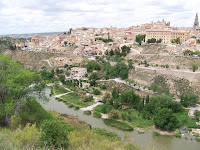
 Ok, here are the pictures of the city. I discovered I had an extra day
since I did some of the other cities faster than anticipated. I spent
an extra day in Toledo, walking around the outside of the city, first on
the city side then opposite it. That walk included a wonderful viewing
platform.
Ok, here are the pictures of the city. I discovered I had an extra day
since I did some of the other cities faster than anticipated. I spent
an extra day in Toledo, walking around the outside of the city, first on
the city side then opposite it. That walk included a wonderful viewing
platform.

 That night I walked part of the route again to get a few pictures.
Of all the cities I visited this was my favourite. Because I bought my swords there? Perhaps. It was also the most medieval of all the cities I visited. The city is built on on a hill surrounded by a river. That means no real changes can be made to the structures. All the streets are narrow and windy (I ended up trapped in the same court for about half an hour, trying different roads out that all looped me back). I originally ignored my map and decided to wander around. Once I decided to get somewhere things got frustrating. It didn't matter how many times I checked the map and the name of the street I thought I was on, I ended up going the wrong way.
 By this time I was rather sick of sightseeing, so while I walked by the cathedral and took some photos, I didn't go inside. I was going to see the Synagogues, but ended up not doing those either.
Instead I wandered and checked out sword shops. They were everywhere and had the most incredible selections. Some were very expensive, but you could get a good sword for very little money. Or better yet, a practice sword. I ended up getting 3 swords, a Lord of the Rings replica with a sheath and two brass handled traditional Spanish blades. They weren't the cheaper blades I was originally going to get


 but as I bought 2 I got a deal.
Oh, and the hostel I stayed at, it's the castle. (Top of the first picture.) The picture beside it is the Alcazar, across a valley and in the city proper.


Spain 7
The Alhambra


Here's the view from St. Nicholas's church, the best view in the city. It took 3 photos, as the complex is large and sprawls across the mountain top.
I'll describe the buildings as I visited them, from right to left.

 I started with the Alcazaba, the military complex. It was basically a set of buildings (now gone, though you can see the foundations where there were several towers, and the view from them was, well, there's a photo. You tell me.) I didn't have much time here, as my ticket for the Palacios Nazarines, was for 10 and I got to the Alhambra complex around 9 (I lined up at 6:30 to get my ticket - as they stop selling once they reach a certain number of visitors). They also limit the number of people in the middle complex at any given time to keep the monument in good repair.


 I spent more time there, though not as much as I would have liked. The walls and ceilings were all carved and patterned. Here's a view from the windows (also carved). The picture beside it is of one of the interior courtyards. This one looks onto the room where the Sultan met with his subjects. The pools are designed so the buildings seem to disappear into them (it's the technique used at the Taj Mahal). The picture beside that is the room itself. The sultan would sit in one of the alcoves, back lit by stained glass windows.


 The next section was the 'lion's fountain' courtyard. The fountain is being restored so the centre of the courtyard's all boarded up. The king's chamber was also closed for repairs. I've got lots of pictures of this side of the courtyard. Again, amazing carvings in everything. The close up shows you some of the detail. I also added a detail of one of the stalactite ceilings. Not all of the ceilings were like this, many were wooden, but the work here was incredible.
The complex ended with another courtyard and a garden.


From there it was a long walk around one curve of the mountain to reach the Generalife garden complex. It was designed as a heavenly garden on earth. Once you reach it the garden takes up most of the hilltop on this side. You can see orchards and other gardens inaccessible to tourists. The buildings here enclose other gardens. Another interesting feature was the water staircase. (There were fountains at each landing and the handrail was a water runway.)


 I'd gone through a different entrance than the one my guide book suggested, so I passed through that one on my way out. The Moors had an eye towards defense. They planned the main gate so that you couldn't move directly from the the outside to the inside, you had to go around corners making an attacking army easier to halt. There were also murder holes in the ceiling for defenders to take out more attackers.
 Outside this gate and down the hill a little was a fountain.
On the path in front of it was a mosaic done in stones. I've put the photo in here not because this was unique, but because a lot of the roads and paths were done this way. Not necessarily with mosaics, but with rocks set inside cement.


Here's the view from St. Nicholas's church, the best view in the city. It took 3 photos, as the complex is large and sprawls across the mountain top.
I'll describe the buildings as I visited them, from right to left.

 I started with the Alcazaba, the military complex. It was basically a set of buildings (now gone, though you can see the foundations where there were several towers, and the view from them was, well, there's a photo. You tell me.) I didn't have much time here, as my ticket for the Palacios Nazarines, was for 10 and I got to the Alhambra complex around 9 (I lined up at 6:30 to get my ticket - as they stop selling once they reach a certain number of visitors). They also limit the number of people in the middle complex at any given time to keep the monument in good repair.


 I spent more time there, though not as much as I would have liked. The walls and ceilings were all carved and patterned. Here's a view from the windows (also carved). The picture beside it is of one of the interior courtyards. This one looks onto the room where the Sultan met with his subjects. The pools are designed so the buildings seem to disappear into them (it's the technique used at the Taj Mahal). The picture beside that is the room itself. The sultan would sit in one of the alcoves, back lit by stained glass windows.

 The next section was the 'lion's fountain' courtyard. The fountain is being restored so the centre of the courtyard's all boarded up. The king's chamber was also closed for repairs. I've got lots of pictures of this side of the courtyard. Again, amazing carvings in everything. The close up shows you some of the detail. I also added a detail of one of the stalactite ceilings. Not all of the ceilings were like this, many were wooden, but the work here was incredible.
The complex ended with another courtyard and a garden.


From there it was a long walk around one curve of the mountain to reach the Generalife garden complex. It was designed as a heavenly garden on earth. Once you reach it the garden takes up most of the hilltop on this side. You can see orchards and other gardens inaccessible to tourists. The buildings here enclose other gardens. Another interesting feature was the water staircase. (There were fountains at each landing and the handrail was a water runway.)


 I'd gone through a different entrance than the one my guide book suggested, so I passed through that one on my way out. The Moors had an eye towards defense. They planned the main gate so that you couldn't move directly from the the outside to the inside, you had to go around corners making an attacking army easier to halt. There were also murder holes in the ceiling for defenders to take out more attackers.
  Outside this gate and down the hill a little was a fountain.
On the path in front of it was a mosaic done in stones. I've put the photo in here not because this was unique, but because a lot of the roads and paths were done this way. Not necessarily with mosaics, but with rocks set inside cement.
Subscribe to:
Posts (Atom)